DAT Hole Punching: Folding and Punching Patterns Explained
Hole punching tests your ability to track how a folded paper unfolds after a hole is punched through it. Use a layer-by-layer method and endless drills to master this PAT subtype.
DAT Hole Punching: Folding and Punching Patterns Explained
Hole punching is one of the most trainable PAT subtypes. The question shows a square paper folded one or more times, then a hole punched through the folded layers. Your job is to identify how the holes appear when the paper unfolds. If you learn the folding rules and practice the right patterns, you can solve these items quickly and accurately. The students who reach top PAT scores treat hole punching as a mirror-and-layer puzzle, not a spatial guessing game.
We see this every cycle: students who skip hole punching because it looks confusing, then discover it is actually one of the easiest subtypes once they learn the mirror rule. This guide explains the step-by-step method, the common traps, and the generator drill routine that makes the patterns automatic. Track the fold order, count layers at the punch point, and apply the mirror rule to unfold the paper correctly. Use single-fold, three-fold, and timed mixed drills with PAT generators that create unique questions every time. Review every error and take full-length tests under timed conditions.
What Is Hole Punching?
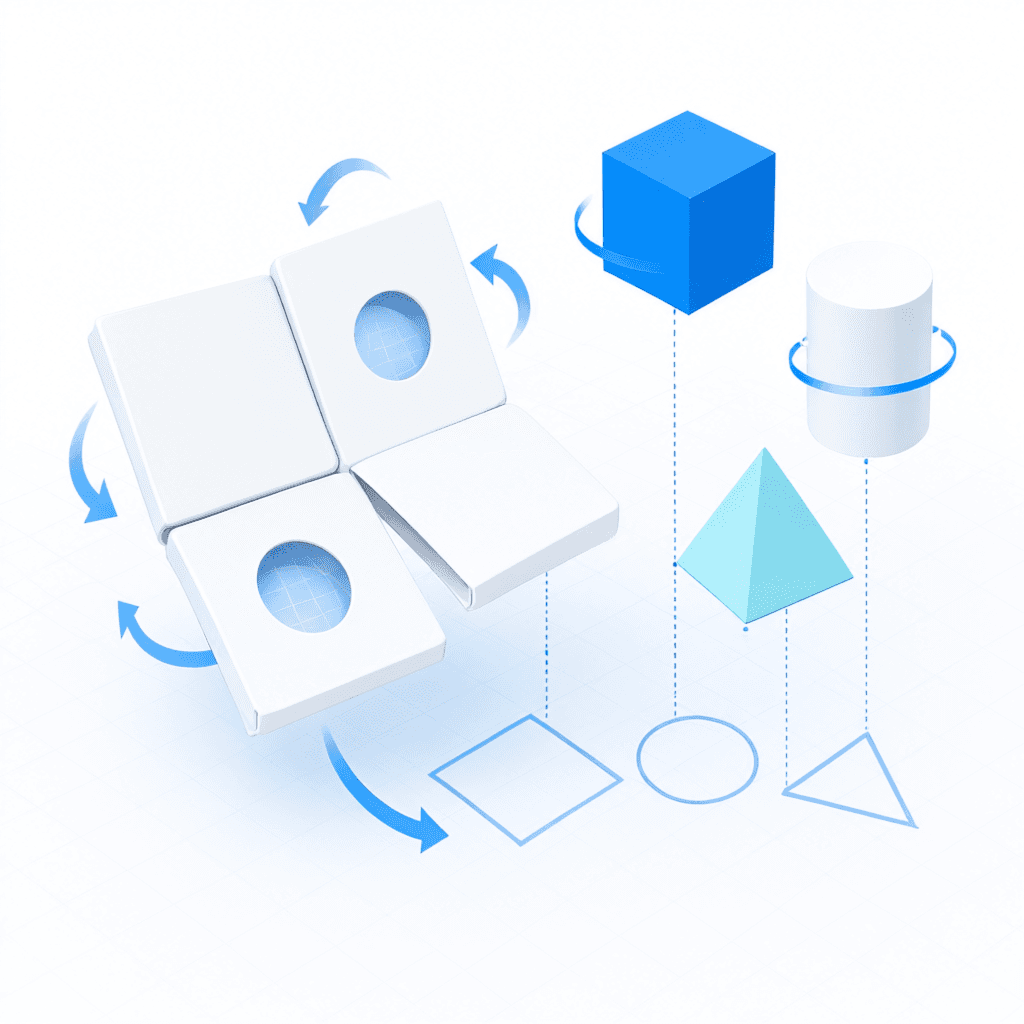
Hole punching is a PAT subtype that tests spatial transformation. You see a square paper folded in a specific sequence, then a hole punch applied at a specific point. The paper is then unfolded, and you must select the unfolded pattern from the answer choices. The folds are always along the grid lines, and the punch goes through all layers at the chosen point. The challenge is to track how many layers exist and where the mirrored holes appear.
How the Folds Work
The paper starts as a square, usually divided into a four-by-four grid. Folds can be horizontal, vertical, or diagonal. Each fold doubles the number of layers in the folded region. One fold creates two layers. Two folds create four layers. Three folds create eight layers. The punch goes through every layer at the punch point, so one punch can create multiple holes when unfolded.
The Step-by-Step Hole Punching Method
Use this exact sequence on every item:
- Read the fold order left to right. The first drawing shows the original square. The next drawings show the first fold, second fold, and final punch. Trace the sequence carefully.
- Count layers at the punch point. After each fold, determine how many layers are stacked at the punch location. A three-fold item can have up to eight layers at the punch point.
- Identify fold symmetry. A vertical fold creates a left-right mirror. A horizontal fold creates a top-bottom mirror. A diagonal fold creates a mirror across the diagonal line. The combination of mirrors determines the final hole pattern.
- Unfold one step at a time. Start from the final folded state and reverse the last fold. Place the hole on both sides of the fold line, then reverse the next fold, and continue until the paper is fully open.
- Match position and count. Look for the exact number of holes and their exact positions. Pay close attention to holes near the fold line because they often appear in pairs.
The Mirror Rule
The mirror rule is the heart of hole punching. Every fold creates a mirror image. If a hole is one unit away from the fold line on the top layer, there will be a matching hole one unit away from the fold line on the mirrored layer. After multiple folds, the mirrors combine, and the holes appear in a symmetrical pattern across the original square.
For example, a vertical fold followed by a horizontal fold creates four layers. The punch appears in one corner of the folded paper. When unfolded, the hole appears in all four quadrants, mirrored across the vertical and horizontal center lines. The exact position depends on how far the punch was from each fold line.
Common Traps in Hole Punching
The mistakes students make are predictable. Avoid these five traps:
- Reversing the fold order: The folds are shown in order. Apply them from left to right, not from right to left. Reversing the order gives the wrong layer count and wrong hole positions.
- Forgetting a layer: A three-fold punch can go through eight layers. Missing one layer means missing one hole in the final pattern.
- Misplacing the mirror axis: The fold line is the axis of symmetry. The hole is mirrored across that line, not across the center of the paper. Use the fold line as the reference.
- Counting holes instead of positions: Answer choices often show the same number of holes in different positions. You need the exact positions, not just the count.
- Ignoring the grid: The square is divided into a grid. Use the grid lines to measure the distance from the hole to the fold line. This makes mirror placement precise.
Timing Strategy for Hole Punching
Hole punching is a medium-speed PAT subtype. Aim for thirty to forty-five seconds per item. The first few folds may take a moment to visualize, but after enough drills the patterns repeat. The time you save on angle ranking and cube counting should cover the slightly longer hole punching items. If a question has three folds and you cannot track the layers quickly, make your best guess and move on. Do not let one item consume a minute of your PAT time.
Generator Drill Routine
The best PAT prep platforms give you generators that create unique new questions every time, covering all six DAT PAT subtypes, including hole punching. Use them in three phases:
- Single-fold drills: Start with one-fold and two-fold items. These teach the mirror rule without overwhelming you with layers.
- Three-fold drills: Once single folds are automatic, move to three-fold items. These are the hardest on the DAT and give the most practice with layer counting.
- Timed mixed drills: Alternate hole punching with other PAT subtypes to practice switching mental models under time pressure.
Because the generator creates unique new questions every time, you can run as many drills as you need. You are not limited by a fixed question bank. That is the difference between exam-specific prep and free resources that run out after a few examples.
How 3D Models and Video Explanations Help
Hole punching is easier when you can see the paper fold and unfold. 3D models in PAT generators show each fold as a step, and video explanations walk through the mirror logic. When you first learn the method, use the 3D view to confirm that your mental unfolding matches the actual geometry. Once you are confident, you can solve the 2D test images faster because you understand the underlying transformation. Look for a platform that includes 3D models and video explanations for every generated question.
Full-Length Practice Tests and Review
Students who reach top-tier PAT scores consistently report that full-length practice tests are the closest thing to a magic bullet. Plan for at least four to five full-length DATs before test day, and seven to ten is better if your schedule allows. Review every question, whether you got it right or wrong. Group your errors by trap and topic in an error log. The real DAT often feels easier than practice, with only one to three obscure questions per section. Take every practice test under timed conditions, including the full break schedule, so your stamina matches what you will face on test day.
Test Day Execution
Use the Prometric Test Drive so you know exactly how the check-in, lockers, and interface feel. Arrive thirty to forty-five minutes early with two forms of valid ID. Take the full thirty-minute break. Track the timer on every section. Dress in layers so you can adjust to the room temperature, and bring a light snack for the break. Avoid forums and group chats for two to three days before the exam. The last-minute panic they spread is not worth the energy drain.
If You Need to Retake or Recover
A lower score is not the end of your dental career. Many students retake successfully. The DAT retake policy requires a sixty-day wait, allows four attempts per twelve months, and after five attempts you need permission once per year. Reschedule fees run $50 to $150, so commit to your date. If you retake, do not repeat the same study plan. Diagnose your score report, then spend about seventy percent of your time on the weakest sections. Fill content gaps, add more timed practice, and manage anxiety with a reset plan.
AI for Hole Punching and PAT Prep
Use an AI tutor for explanations, custom questions, flashcards, and summaries for the PAT. Always verify the output against official or prep-course sources. AI is a supplement, not a replacement for your own reasoning. The best tools are exam-specific and aligned to the DAT blueprint, so the explanations match the format you will see on test day. An adaptive quiz generator and flashcard generator can help you build hole-punching drills and review cards on demand, but only if the output is grounded in the actual DAT format.
Do Not Neglect Quantitative Reasoning
QR is often treated as an afterthought, but we see this every cycle: it is free points for your Academic Average if you put in the work. The section has forty questions in forty-five minutes. Use a two-pass strategy: answer the straightforward items first, then return to the harder ones. Common topics include algebra, rates and ratios, probability, unit conversions, and data interpretation. Watch the wording traps. Use the calculator sparingly and drill mental math. The time you save on hole punching can help across the whole exam, but only if you respect every section.
Hole punching is one of the most trainable PAT subtypes. The mirror rule and layer count are the same on every item, no matter how the paper is folded. Learn the method, avoid the common traps, and use endless generator drills to build speed and confidence. If you want PAT generators that create unique questions every time for hole punching and every other PAT subtype, plus 3D models and video explanations, look for a platform that covers all six subtypes with unlimited drills. Crack the DAT is built for that.
Ready to crack the DAT?
Crack the DAT gives you 10 full-length practice tests, PAT generators that generate unique new questions every time, 100+ hours of video crash courses, the largest arsenal of PAT practice tests with 3D models and video explanations, 50,000+ flashcards, and a complete study engine: Adaptive Quiz Generator, Adaptive Flashcard Generator, AI Tutor, Homework Helper, YouTube Summarizer, and Study Schedule Creator. Everything is aligned to the official DAT blueprint and comes with unlimited tokens, unlimited credits, no throttling, unlimited access, and unlimited usage. No subscriptions, no usage caps.
No credit card required for the free trial. One-time payment for full access.
Related articles
How to Study for the DAT PAT Section: Strategies and Practice Tools
A complete guide to the DAT PAT section. Learn strategies for all six subtypes, build timing, and use PAT generators that generate unique new questions every time, each with 3D models and video explanations.
PATDAT Angle Ranking: How to Master the PAT's Fastest Subtype
Angle ranking is the fastest DAT PAT subtype, but only if you have a reliable sorting method. Learn the step-by-step strategy, timing targets, and generator drills that turn this section into quick points.
PATDAT Cube Counting: PAT Strategy for 3D Block Problems
Cube counting tests how well you can count painted faces on a 3D block structure. Use a systematic method, avoid hidden-cube traps, and practice with endless generator drills.
Turn strategy into a top DAT score
10 full-length DAT tests, unlimited PAT generators, 100+ hours of video, and unlimited AI tools. Start today.
Unlock Everything